Redesigning R134a cooling units for R290
Moving an R134a Cooling Unit to R290: A Redesign Guide for OEMs
If your product contains an R134a refrigeration unit and you are considering R290, start with the complete product design. The short answer: **R290 (propane) is not a drop-in replacement for R134a.** Moving to R290 means redesigning the refrigeration circuit and its safety concept, while ideally keeping your product's function, interfaces and housing. Van West Cooling develops and manufactures compact R290 cooling units for OEM equipment. We redesign the cooling around your existing product, validate it inside your product and build it in series at our facility in the Netherlands.

Why OEMs are moving away from R134a now
High GWP
Under the EU F-gas Regulation (EU) 2024/573, the climate impact of HFCs is expressed in 100-year GWP values from the IPCC Fourth Assessment Report. For R134a that value is 1,430. R290 has a GWP of 0.02 (European Commission).
A tighter HFC quota from 2027
The amount of HFCs that may be placed on the EU market is capped in tonnes of CO2 equivalent. A new quota period starts on 1 January 2027 (Implementing Decision (EU) 2026/1382), with an annual maximum of 21,665,691 tonnes CO2 equivalent, compared with 42,874,410 per year in 2025–2026: a reduction of about 49.5% (Annex VII of the Regulation). This is an EU-wide HFC ceiling in CO2 equivalent, not a halving of physical tonnes of R134a. Because quota is counted in CO2 equivalent, high-GWP refrigerants use up more of it.
Product restrictions depend on the product category
Since 1 January 2025, Annex IV, point 4 generally prohibits placing self-contained refrigeration equipment other than chillers on the EU market with F-gases of GWP 150 or more, unless required to meet safety requirements at the site of operation. Specific temporary derogations also apply to certain equipment: for example, qualifying laboratory centrifuges are covered through 31 December 2028 under Implementing Regulation (EU) 2024/2729. Chillers follow separate rules and dates, explained on our page on R290 chillers for OEM equipment. Which rule applies to your product has to be established per product.
The EU PFAS restriction is in progress
The proposed EU-wide PFAS restriction under REACH also addresses uses of fluorinated gases, including refrigeration. ECHA has published a final Risk Assessment Committee opinion and a draft Socio-Economic Analysis Committee opinion. The ECHA process record and subsequent updates must be checked before publication: a proposal or committee opinion is not an adopted ban. The final legal scope, derogations and dates remain subject to the EU decision-making process.
Taken together: a product that will still be produced in several years' time is worth redesigning in a planned way now, rather than under supply or regulatory pressure later.
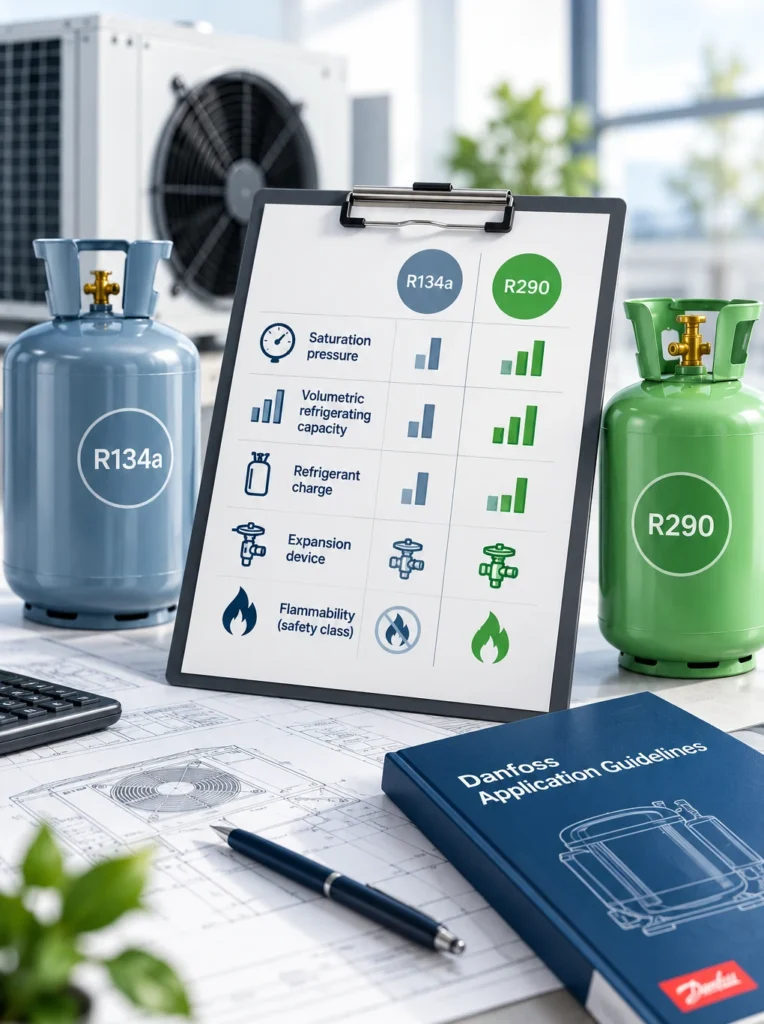
Why R290 is not a drop-in for R134a
R290 differs from R134a in thermodynamic properties and safety classification. Compressor manufacturer Danfoss gives the following illustrative comparisons for small hermetic systems. These are reference conditions, not design rules or approved conversion factors for your product (Danfoss application guidelines):
| Design aspect | What changes with R290 compared with R134a |
|---|---|
| Saturation pressure | At −25 °C, the cited table gives about 2.03 bar absolute for R290 versus 1.07 bar absolute for R134a (about 1.9 times). The ratio changes with temperature and is not a general operating-pressure multiplier |
| Volumetric refrigerating capacity | Danfoss gives roughly 150 % of R134a for its comparison at 45 °C condensing, 32 °C suction gas and no subcooling. Required compressor displacement must be selected from manufacturer performance data at the actual design conditions |
| Refrigerant charge | The older guide illustrates a mass ratio around 40–45 % for comparable liquid volume. Determine and validate the charge for the redesigned circuit; do not use a percentage to refill an existing R134a unit |
| Expansion device | Must be re-selected; capillary flow rates for R290 are closer to those for R404A |
| Flammability | R290 is flammable (safety class A3); components and safety concept must be designed for it |
The last point is decisive. Danfoss explicitly advises against converting an R134a system to R290, because such systems were not designed or approved for a flammable refrigerant. Electrical components that can spark, the enclosure, ventilation and leak scenarios all have to be part of the design.

What a redesign involves
1. Baseline of the existing unit
We start by evaluating how your existing cooling unit performs inside your product.
This includes cooling capacity at actual operating conditions, ambient and product temperatures, duty cycle, power consumption, noise levels, dimensions and interfaces.
These parameters form the specification for the R290 redesign, allowing performance to be compared under equivalent conditions.
2. Circuit and component design
Our engineers develop the refrigeration circuit and select components suitable for R290. This includes the compressor, condenser, evaporator, expansion device and refrigerant charge. The objective is to achieve the required cooling performance while keeping the design as compact and efficient as the application allows.
3. Safety concept
Safety is an integral part of the redesign process.
We assess refrigerant charge, component positioning, potential ignition sources, enclosure ventilation and possible leak scenarios. The applicable standards depend on the finished OEM product and its intended application.
Read more about our approach to Quality & Certifications.
4. Integration into your product
Where possible, we preserve the existing mechanical mounting, connections, control interfaces and heat-rejection path. This allows the redesign to remain largely within the cooling unit. If modifications to the surrounding OEM product are necessary, we identify them early in the development process.
Replacing an R134a cooling unit in a laboratory instrument? Our guide to cooling units for laboratory equipment covers design considerations for refrigerated centrifuges and recirculating chillers.
5. Validation and series production
Prototypes are built using production components and tested under representative operating conditions. Testing includes refrigeration performance, leak and pressure testing, and noise assessment. Once validated, the cooling unit can move into series production at our manufacturing facility in the Netherlands. Our production process includes automated refrigerant charging, end-of-line testing and product traceability.
Learn more about our production process.

What the change can bring
Published manufacturer cases show that a redesign can do more than replace the refrigerant. In a 2019 case study of a horizontal commercial freezer, Tecumseh replaced an R134a compressor of 10.61 cm³ displacement with a 7.84 cm³ R290 condensing unit; the refrigerant charge fell by 54 % and measured power consumption fell from 264 W to 195 W (Tecumseh case study). The condenser, fan and compressor speed also changed, so the improvement cannot be attributed to the refrigerant alone. This is an external freezer case, not a prediction of VWK performance or a result for every OEM application.

Plan extra time for regulated end products
In medical, laboratory and other regulated equipment, a new cooling unit can trigger re-testing or re-assessment of the end product. Include that in the planning from the start, and keep the change contained within a clearly defined cooling module where possible. By keeping the redesign within a clearly defined cooling module wherever possible, Van West Cooling aims to minimise unnecessary modifications to the surrounding OEM equipment.
Switching an existing medical or therapy device from R134a to R290? Our guide to cooling units for medical and therapy devices explains what to consider when redesigning the cooling unit and planning verification tests for the complete device.

Frequently asked questions
Can we simply refill our existing R134a unit with R290?
No. R290 runs at different pressures and needs a different compressor, expansion device and charge, and the unit must be designed for a flammable refrigerant. Converting an existing R134a system is not recommended; the cooling unit has to be redesigned.
Is R290 more efficient than R134a?
R290 has favourable thermodynamic properties compared with R134a, including a higher volumetric refrigeration capacity. This can enable compact cooling system designs and potentially improve energy efficiency.
However, higher refrigeration capacity does not automatically mean lower energy consumption. Actual efficiency depends on the compressor, heat exchangers, operating temperatures and overall system design. A properly engineered R290 cooling unit can achieve equal or better energy efficiency than an R134a system, but performance should always be verified under the intended operating conditions.
Can you keep our existing housing and interfaces?
That is usually the aim. We design the cooling system around your product and test prototypes inside it. If a change to the product is needed, we identify it early in the project.
Will R134a be banned in our product?
That depends on the product category and its use. Some categories are already restricted under the F-gas Regulation, others follow different dates, and the EU PFAS restriction is still being decided. Have your product classified; the EU HFC quota can affect supply conditions, but it does not by itself mean that existing R134a equipment is banned from use or that a specific price change is certain.
Talk to our engineers about your R134a unit
Still building products with an R134a cooling unit? Send us the specifications of the current unit, your operating conditions and the expected annual volume. Our engineers will assess what an R290 redesign involves for your product and outline the route to series production.
Sources