Cooling Units for Medical and Therapy Devices
Stable temperatures, quiet operation, compact integration
Are you developing a medical or therapy device that has to cool a patient interface, a liquid or an internal component? Then the cooling unit has to hold a stable temperature for hours, run quietly close to patients and fit inside a compact housing. Depending on the legal classification of the cooling system, the EU's restrictions on small stationary chillers from 1 January 2027 may also affect your design. Van West Cooling develops and manufactures compact refrigeration units that OEMs build into their own equipment, including units with the natural refrigerant R290, from prototype to series production in the Netherlands. You remain the manufacturer of the medical device; we develop and build the cooling module that goes into it.
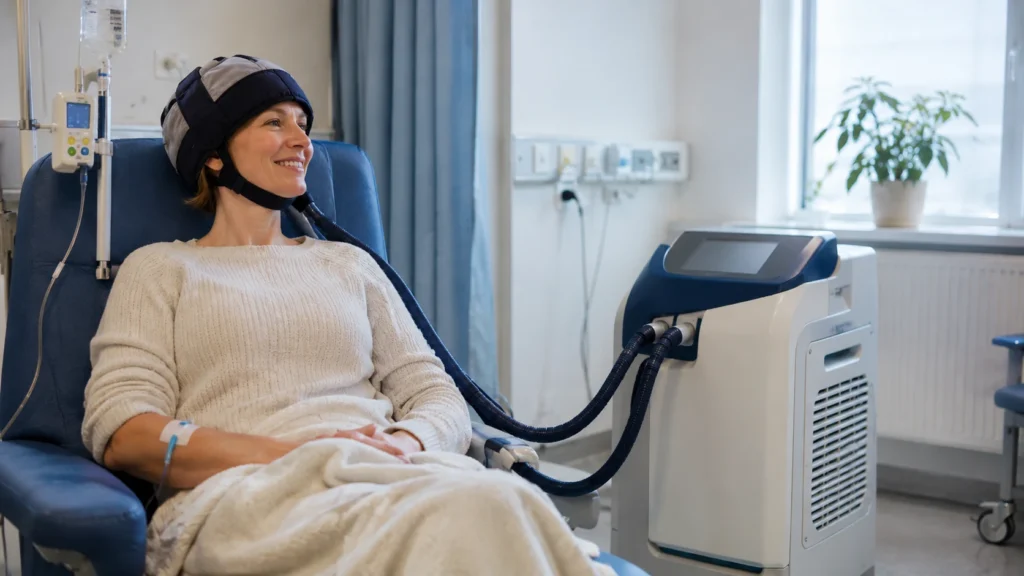
Where compact cooling is used in medical and therapy equipment
| Application type | What is cooled | Key design question |
|---|---|---|
| Cold therapy devices (for example scalp cooling, cold compression or localised cooling) | A coolant circulated through a cap, pad or wrap | A stable coolant temperature at the patient interface throughout a long treatment |
| Patient temperature management | Water for pads or blankets, often combined with heating | Fast pull-down and accurate control at changing heat loads |
| Imaging, laser and power electronics | A liquid loop that removes heat from a tube, laser source or electronics | Peak heat load in a small space, with quiet heat rejection into the room |
| Sample, blood and specimen cooling | Air or a cold plate inside an insulated compartment | Temperature uniformity and recovery after the lid or door is opened |
These are examples of cooling requirements across the sector, not claims that Van West Cooling has supplied these medical applications or that a cooling module is itself certified as a medical device. Suitability and applicable device safety requirements must be assessed for each project. Developing a refrigerated centrifuge or recirculating chiller? Explore our cooling units for laboratory equipment.
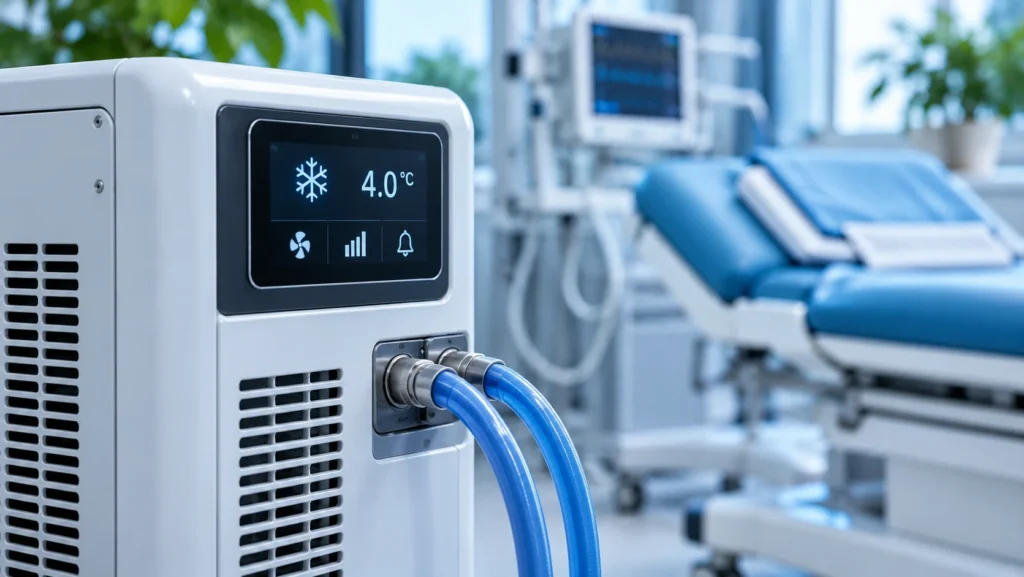
What the cooling unit must deliver in a medical device
- Stable temperature where it matters. Specify the temperature at the patient interface or component, not only at the cooling unit outlet. Agree which temperatures, alarms and status signals the unit exchanges with your device controller, so they can be covered in your risk management.
- Low noise and vibration. Treatment rooms, wards and bedside use call for a quiet compressor, a well-chosen fan speed and mounting that limits vibration.
- Heat rejection in a clinical room. The condenser needs fresh air and must not recirculate its own warm exhaust. Define the warmest room in which your device must perform, and the acceptable exhaust and housing temperatures.
- Duty cycle and reliability. Many therapy devices run for hours per treatment and several treatments per day. Component selection and end-of-line testing should reflect that duty cycle.
- Condensate and cleaning. Cold lines and plates collect condensation. Drainage, insulation and cleanable surfaces belong in the design from the start.
- Service over the device lifetime. A cooling module that can be replaced as one unit simplifies service in the field.
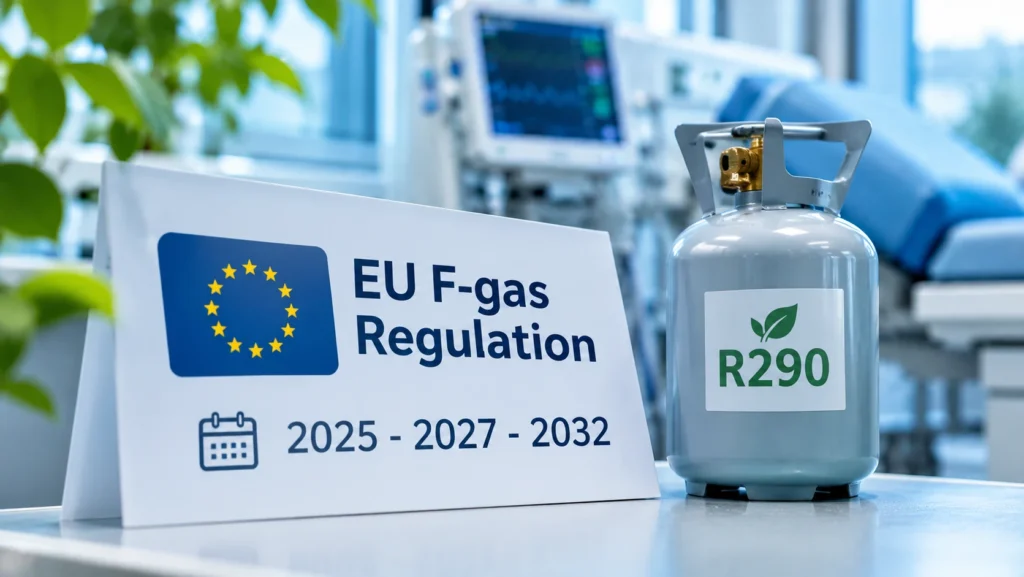
Refrigerant choice: what the EU F-gas Regulation means for medical equipment
Medical equipment is not exempt as a category from the product bans in Annex IV of the F-gas Regulation (EU) 2024/573. Two bans are especially relevant for compact cooling:
- Since 1 January 2025: self-contained refrigeration equipment, except chillers, may not be placed on the EU market if it contains F-gases with a GWP of 150 or more, unless this is required to meet safety requirements at the site of operation (Annex IV, point 4).
- From 1 January 2027: stationary chillers with a rated capacity of up to 12 kW may not be placed on the EU market if they contain F-gases with a GWP of 150 or more, again with an exception where required to meet safety requirements (Annex IV, point 7(b)). From 1 January 2032 this applies to all F-gases in this class (point 7(c)).
The regulation defines a chiller as a single system whose primary function is to cool a heat transfer fluid. Some therapy and imaging systems circulate cooled water or another liquid through a pad, cap or heat source. But a coolant loop alone does not settle the legal classification of the equipment placed on the market. Whether the refrigeration module or the complete device falls under the chiller rules, self-contained refrigeration rules or another category requires a product-specific assessment.
The European Commission has granted specific, time-limited exemptions for certain products; these do not create a general medical-device exemption. For example, blood transport boxes and blood plasma contact shock freezers with F-gases of GWP 150 or more may be placed on the market until 31 December 2026 (Implementing Regulation (EU) 2024/3122). Mechanical cryogenic freezers (–150 °C) are exempted until 31 December 2028 (Implementing Regulation (EU) 2024/3120). Both exemptions apply only to those products and require labelling. They are not a basis for planning a new device.
R290 (propane) is not an F-gas and has a GWP of 0.02 (European Commission). It is flammable (safety class A3), so charge, component selection, ignition sources and airflow through the enclosure have to be designed for it. If integrated into a medical device, refrigerant flammability must also be covered by the device manufacturer's risk management (typically under ISO 14971) and by the applicable product safety assessment. Compliance of the refrigeration unit alone does not establish conformity of the complete medical device. See Quality & Certifications for the standards we design our cooling units to. For more on R290 chillers for OEM equipment, read R290 chillers for OEM equipment.
Changing the cooling in an existing medical device
Does your device currently use an R134a or other HFC cooling unit? Moving to R290 is a redesign, not a refrigerant swap: it involves a different compressor, expansion device and charge, and a design suitable for a flammable refrigerant. Where possible, we keep your mounting, connections and controller interface. Read how we redesign R134a cooling units for R290.
Under the Medical Device Regulation (EU) 2017/745, the device manufacturer must assess the change through its own change-control process. Where a relevant notified-body certificate covers the approved design and the change could affect safety, performance or conditions of use, prior notified-body approval may be required (see Annex IX, section 4.10; other conformity routes have their own requirements). Plan the verification tests of the modified device early, so the cooling redesign does not become the bottleneck in your timeline.
How we develop cooling for medical OEMs
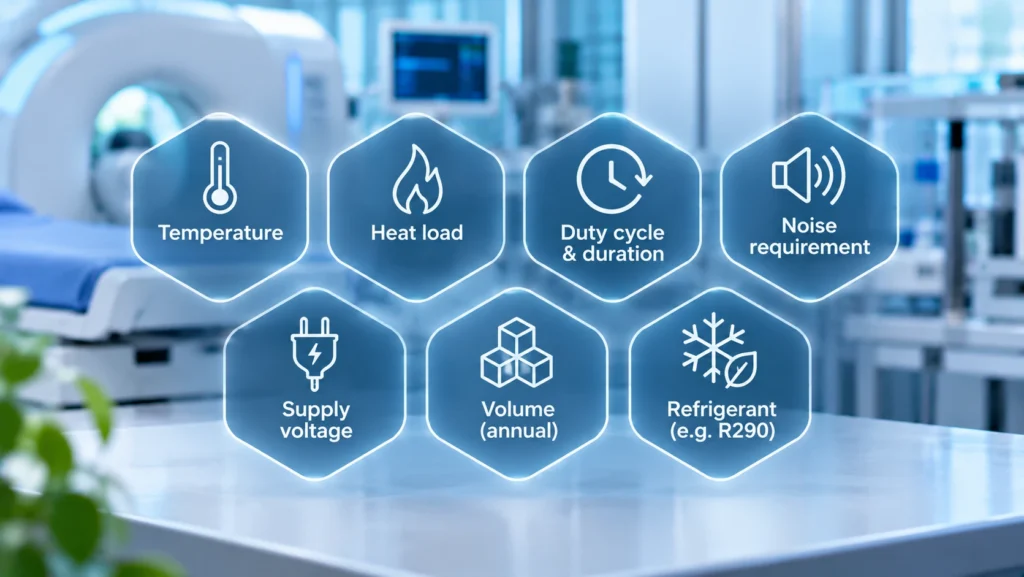
We design the cooling unit around your device: from heat load and required temperatures to concept, component selection and a prototype that you test in your own equipment. After approval, we build the unit in series in the Netherlands, with automated refrigerant charging and end-of-line testing. Read more about our production process.
For a first technical assessment, please send us:
- Device and medium: the type of device and what is cooled (coolant loop, air, cold plate or a component).
- Temperatures and heat load: the required temperature at the patient interface or component, and the heat load at peak.
- Duty cycle: treatment duration, number of cycles per day and required pull-down time.
- Conditions and integration: the warmest room temperature, noise requirements, available space, supply voltage and the interface with your controller.
- Current situation and volume: the refrigerant used today (if any), the expected number of devices per year and your timeline.

Frequently asked questions
Are medical devices exempt from the EU F-gas bans?
No, not as a category. The bans in Annex IV of Regulation (EU) 2024/573 also apply to refrigeration equipment used in healthcare. The exemptions granted so far cover specific products only, such as blood transport boxes and blood plasma contact shock freezers (until 31 December 2026) and mechanical cryogenic freezers at –150 °C (until 31 December 2028).
Can R290 be used in a medical device?
The F-gas Regulation does not restrict R290, because it is not a fluorinated gas. Using it is a product safety question: the cooling unit must be designed for a flammable refrigerant, and the refrigerant must be covered in the risk management and safety assessment of the complete device.
Do you supply complete medical devices?
No. We develop and manufacture the cooling unit or module that goes into your device. The device, its intended purpose and its conformity under the Medical Device Regulation remain your responsibility.
Discuss the cooling of your medical device with our engineers
Developing a new therapy or medical device, or replacing an HFC cooling unit before the 2027 chiller deadline? Send us your required temperatures, heat load, duty cycle and expected annual volume. Our engineers will assess which cooling concept fits and outline the route from prototype to series production.
Talk to our engineers
Sources