R290 Chillers for OEM Equipment
Compact cooling: engineered for series production
Van West Cooling develops and builds custom R290 chillers up to approximately 2 kW for integration into OEM equipment. Engineered and manufactured in the Netherlands, in series of 100 to 10,000 units per year.
Preparing for the 2027 and 2032 F-gas restrictions? Explore what the rules mean for your product and how R290 can support your next design.

Does the 2027 ban apply to your product?
From 1 January 2027, new stationary chillers up to 12 kW may only be placed on the EU market with a refrigerant below GWP 150. From 1 January 2032, fluorinated refrigerants are excluded from this class altogether. Both prohibitions have the same exception: where fluorinated gases are required to meet safety requirements at the site of operation. If your product is or contains such a chiller, check now whether it is affected.
The EU F-gas Regulation, (EU) 2024/573, defines a chiller as a single system whose primary function is to cool a heat transfer fluid, such as water, glycol or brine. If your product does that, these dates apply:
| Chiller capacity | Not allowed on the EU market | From |
|---|---|---|
| Up to 12 kW | F-gases with GWP ≥ 150 | 1 January 2027 |
| Up to 12 kW | All F-gases, including HFOs | 1 January 2032 |
| Above 12 kW | F-gases with GWP ≥ 750 | 1 January 2027 |
Not every built-in cooling system is a chiller in this sense. If your product cools something other than a fluid, it most likely counts as self-contained refrigeration equipment. For that category, the GWP 150 limit has applied since 1 January 2025, with temporary exemptions for some product groups, such as laboratory centrifuges until 31 December 2028. The classification depends on the primary function of the product you place on the market, so check it per product, if needed with your compliance advisor.
All three chiller prohibitions apply except where fluorinated gases are required to meet safety requirements at the site of operation. The European Commission can also grant temporary exemptions for specific equipment, as it did in 2026 for certain chillers used in semiconductor manufacturing.
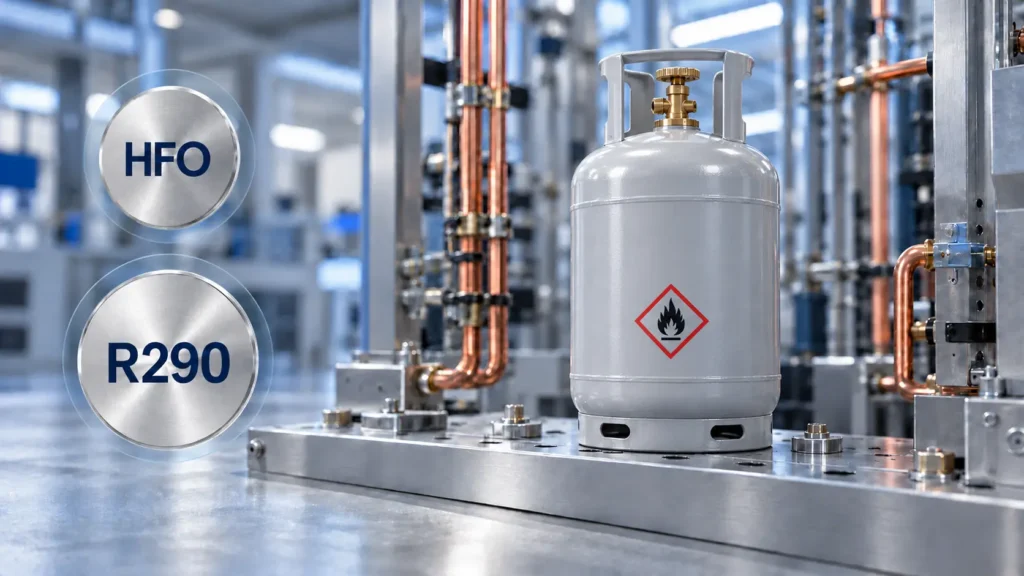
Why R290 instead of an HFO
HFOs such as R1234yf and R1234ze meet the 2027 limit. They are fluorinated gases, however, so from 2032 they fall under the ban for chillers up to 12 kW as well, unless the safety exception applies. For most products, choosing an HFO now means planning a second redesign before 2032.
R290 (propane) is a natural refrigerant with a GWP of 0.02 under the F-gas Regulation. It suits small, efficient systems, and compressors and components for it are widely available. It is flammable, so safety is part of the design from the start.
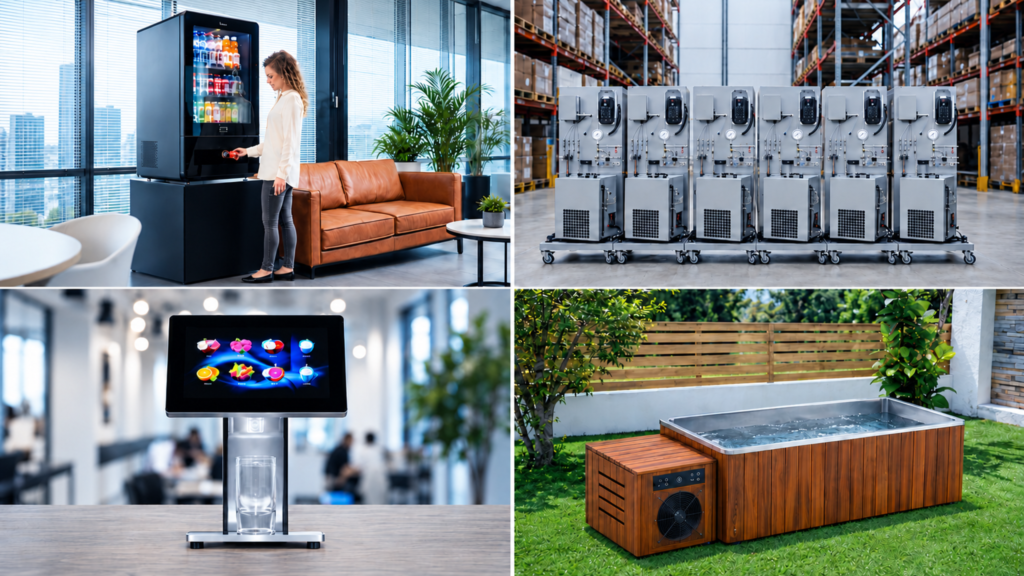
Where our R290 cooling fits
We design the cooling system around your product. Our custom cooling solutions cover four application areas:
- Food & beverage: restaurant and kitchen equipment, beverage cooling, and food preparation and serving units.
- Equipment cooling: machine and electronics cooling, laboratory and test equipment, and industrial process equipment.
- Water technology: drinking water systems, water treatment installations and process water cooling.
- Temperature control: climate and environmental control systems, technical equipment cooling and precision temperature applications.
Working on a different application? If it needs up to approximately 2 kW of cooling capacity in series of 100 to 10,000 units per year, we are happy to assess whether it fits.
Development and production stay in the Netherlands, without offshore assembly.
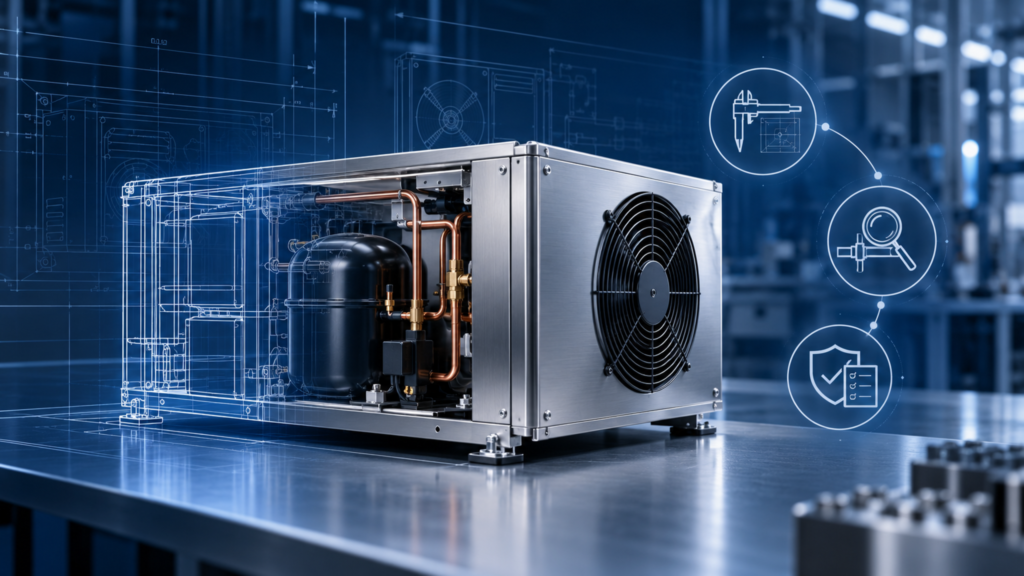
Design and safety with R290
With R290, the refrigerant charge, the component layout and the safety concept are designed together. The maximum permitted charge depends on the product category, the applicable standards and the safety assessment, so it is determined per application and product design.
Which directives and standards apply depends on your product and its function, and we establish that with you at the start of each project. Our design work draws on standards such as EN 378, the EN IEC 60335 series, EN IEC 60079-10-1 for explosive atmospheres and NPR 7600 for flammable refrigerants. It also takes into account the new Machinery Regulation (EU) 2023/1230, which applies from 20 January 2027. See Quality & Certifications for our compliance approach.

From requirements to series production
- Requirements: cooling capacity, fluid and temperature range, ambient conditions, available space, noise targets, power supply and expected annual volume.
- Design: thermal design and R290 component selection, mechanical and 3D design, airflow and integration into your housing, and design for manufacturability.
- Prototypes and validation: prototypes built from production components and tested on their own and inside your product, for capacity, leaks and pressure, noise and vibration, and system balance.
- Series production: automated refrigerant charging, end-of-line testing and full traceability for every unit. Read more about our production process.
What to check now
- Does your product meet the chiller definition, with a rated capacity of 12 kW or less?
- Which refrigerant does it use, and what is its GWP?
- How many units will you place on the EU market after 1 January 2027?
The ban applies to each unit placed on the market, not to the date a design was approved. A redesign that starts now can still be validated properly, but the timeline is tight. If 2027 comes too soon for one product, base its successor on R290, which avoids the scheduled F-gas phase-outs for this category.

Frequently asked questions
Does the ban apply to chillers that are already installed?
No. It covers placing new equipment on the EU market. It does not prohibit using chillers that are already installed. Separate rules apply to servicing and refrigerant use.
Can an existing R134a chiller be converted to R290?
Not by swapping the refrigerant. R290 is flammable and behaves differently, so components, electrical parts and the safety concept must be designed for it. In practice this is a redesign, which is also a chance to improve efficiency, noise and size.
Is R290 safe in compact OEM equipment?
Yes, when the system is designed for it: a limited charge, no ignition sources near possible leak points, a sealed and leak-tested circuit, and a risk assessment for explosive atmospheres.
Does the EU PFAS restriction affect R290 chillers?
The EU is preparing a broad PFAS restriction under REACH. ECHA's risk committee includes fluorinated gases, HFOs among them, in its scope, and the final socio-economic opinion is expected by the end of 2026. R290 is not a PFAS, so the refrigerant itself falls outside the proposed restriction.
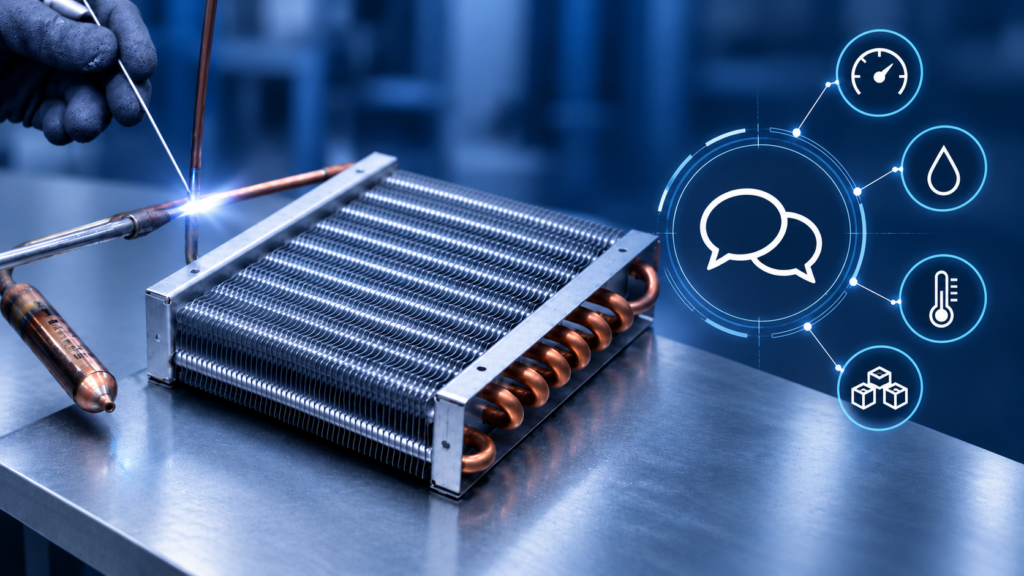
Talk to our engineers about your chiller
Planning a chiller redesign for 2027 or 2032? Send us your required cooling capacity, fluid, temperature range and expected annual volume. Our engineers will assess the feasibility with you and outline the route to series production.
Talk to our engineers
Sources