Cooling Units for Laboratory and Test Equipment
Stable temperatures, compact OEM integration
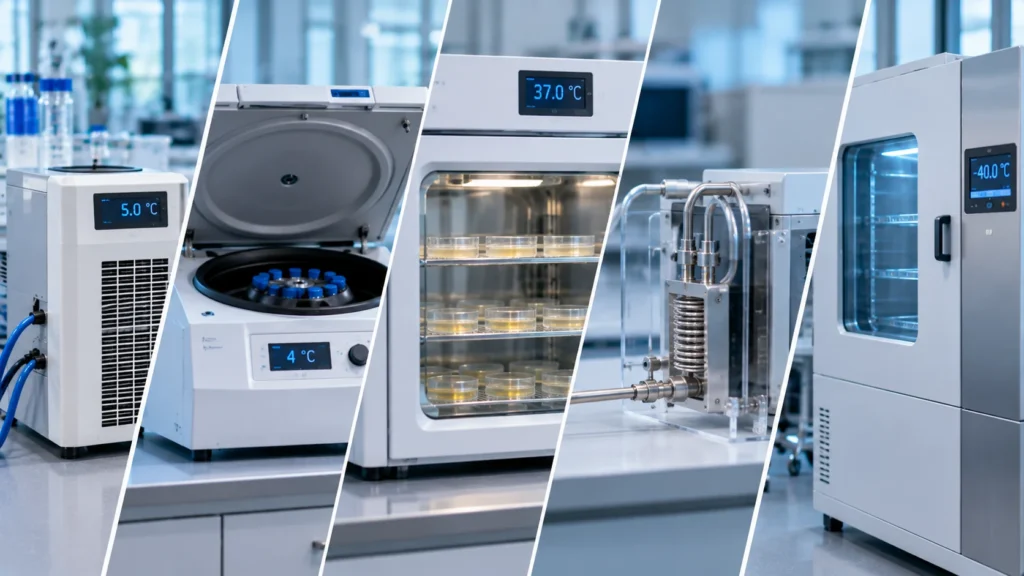
Are you developing laboratory or test equipment with built-in refrigeration, such as a recirculating chiller, a refrigerated centrifuge, an incubator or a sample gas cooler? Then the cooling unit must hold a precise temperature at changing heat loads, run quietly on a lab bench and fit inside a compact housing. From 1 January 2027, new stationary chillers rated up to 12 kW containing F-gases with a GWP of 150 or more can no longer be placed on the EU market, unless a specific exception applies. Certain laboratory equipment has a separate, narrowly defined temporary exemption, but this does not cover recirculating chillers as a category. Van West Cooling develops and manufactures compact R290 cooling modules for integration into OEM equipment, from prototype to series production in the Netherlands. We assess each laboratory application for technical and safety suitability.

Where compact cooling is used in laboratory and test equipment
| Equipment type | What is cooled | Key design question |
|---|---|---|
| Recirculating chillers for rotary evaporators, reactors and analytical instruments | A heat-transfer liquid circulated to external equipment | Cooling capacity and temperature stability at the required flow, ambient and process load |
| Refrigerated centrifuges | Air in the rotor chamber | Fast pull-down and holding temperature against heat from rotor and motor |
| Refrigerated incubators and shakers | Air in the chamber, often combined with heating | Accurate control just above and below ambient, with low vibration |
| Sample and gas coolers for analysers | A liquid sample or measuring gas, sometimes to remove condensable moisture | A stable sample temperature or specified outlet dew point without compromising sample integrity |
| Test and conditioning equipment | A test object, fluid or chamber | Repeatable temperature profiles |
These are examples of cooling requirements in the sector, not a list of applications Van West Cooling has supplied. Suitability is assessed per project.
What the cooling unit must deliver in a laboratory instrument
- Stability under changing load. Specify the temperature stability at the point of use, together with the load profile, such as the start of a distillation or the acceleration of a rotor. Capacity control and controller tuning determine how well the unit follows these changes.
- Capacity at the lowest set point. A compressor system generally delivers less cooling capacity at a lower evaporating temperature under otherwise comparable conditions. Specify the heat load, circulating medium, flow and ambient conditions at your lowest operating temperature, not only at room temperature.
- Noise and heat on the bench. Laboratories are shared workplaces. Fan speed, airflow direction and compressor mounting determine noise, vibration and where the warm exhaust air goes.
- Cooling and heating. Some instruments require control both below and above ambient temperature. Agree early whether heating is provided by the OEM instrument or is specifically included in the cooling-module specification; it is not assumed to be a standard VWK function.
- Interface with your controller. Agree which set points, temperatures, alarms and status signals the unit exchanges with your instrument.
- Continuous duty and documentation. Lab equipment often runs day and night. End-of-line testing and traceability per unit support your own quality documentation.

Which F-gas rules apply to laboratory equipment?
The EU F-gas Regulation (EU) 2024/573 contains no blanket exemption for laboratory equipment. The decisive factors are the refrigeration function, equipment configuration, legal product category and the item being placed on the EU market. A factory-made OEM cooling module and a complete laboratory instrument should not automatically be assigned the same category:
| Equipment category | Rule in Annex IV | Status |
|---|---|---|
| Equipment legally classified as a stationary chiller up to and including 12 kW, including many stationary lab recirculators | Point 7(b): restriction on placing new equipment with F-gases of GWP 150 or more on the EU market from 1 January 2027; point 7(c): all F-gases restricted from 1 January 2032 | The exemption for specified laboratory equipment under 2024/2729 does not cover chillers; the site-safety exception and any other specifically applicable derogation must be assessed individually |
| Qualifying laboratory centrifuges; equipment for spray- or freeze-drying liquid samples; environmental simulation test chambers used for applications below –50 °C | Point 4 would otherwise restrict self-contained refrigeration equipment (except chillers) with F-gases of GWP 150 or more from 1 January 2025 | The specific equipment described in Article 1 of Implementing Regulation (EU) 2024/2729 is exempt from that point until 31 December 2028, subject to the Article 12(2) labelling condition |
| Other self-contained refrigeration equipment that is not classified as a chiller | Point 4 | New equipment containing F-gases with GWP 150 or more generally cannot be placed on the EU market since 1 January 2025, subject to site-safety requirements and any specific derogation |
Article 3(44) defines a chiller as a single system whose primary function is cooling a heat-transfer fluid. Article 3(20) defines stationary equipment as not normally in transit during operation; being movable between workbenches does not, by itself, mean the equipment is mobile under this definition. An integrated analyser, centrifuge or standalone OEM module may need a different product classification. The temporary laboratory exemption applies only to the specified equipment, not automatically to every component later incorporated into it.
On 11 November 2026, the European Commission published two specific derogations from the 2027 chiller restriction: for certain chillers used with machine tools (Implementing Regulation (EU) 2026/2485) and for certain medical chillers used in critical care (Implementing Regulation (EU) 2026/2491). Neither creates a general exemption for laboratory chillers; the precise product scope and conditions in each implementing regulation must be checked.
Developing a medical or therapy device? Explore our cooling units for medical and therapy devices.

R290 in laboratory instruments
R290 (propane) is not an F-gas and has a GWP of 0.02 (European Commission). It is flammable (safety class A3), so charge size, component selection, ignition sources and airflow through the housing must be designed for it. The OEM must assess the safety of the complete instrument under the standards and legislation applicable to its intended use. The EN IEC 61010 series is frequently relevant to electrical laboratory equipment; EN IEC 61010-2-011 specifically addresses refrigerating equipment within its scope. Applicability and permitted refrigerant charge depend on the complete product design. VWK does not claim that a standalone module automatically establishes compliance of the instrument. See Quality & Certifications for the regulations and standards we apply to our cooling units, and R290 chillers for OEM equipment for our chiller development.

Redesigning an existing instrument for R290
Does your instrument use R134a or an HFC blend such as R513A or R452A today? Moving to R290 is a redesign, not a refrigerant swap: it means a different compressor, expansion device and charge, and a design suitable for a flammable refrigerant. Where possible, we keep your mounting, connections and controller interface. Read how we redesign R134a cooling units for R290.
For laboratory centrifuges and the other exempted https://vanwestcooling.com/wp-admin/post.php?post=778&action=edit#product groups, the exemption runs until 31 December 2028. Development, testing and the safety assessment of a redesigned instrument take time, so plan the transition well before that date.

How we develop cooling for laboratory OEMs
We design the cooling unit around your instrument: from heat load and temperature range to concept, component selection and a prototype that you test in your own equipment. After approval, we manufacture cooling modules in series at our facility in the Netherlands, using automated refrigerant charging, end-of-line testing and unit-level production traceability. Read more about our production process.
For a first technical assessment, please send us:
- Instrument and medium: the type of equipment and what is cooled (fluid loop, chamber air, sample or gas).
- Temperatures: the operating range, the lowest set point and the required stability at the point of use.
- Heat load: the heat load at your lowest set point and at peak.
- Duty cycle: continuous or intermittent operation, and the required pull-down time.
- Conditions and integration: maximum room temperature, noise requirements, available space, supply voltage and the interface with your controller.
- Current situation and volume: the refrigerant used today (if any), the expected number of units per year and your timeline.

Frequently asked questions
Are laboratory chillers exempt from the 2027 EU chiller ban?
No general exemption exists for laboratory chillers. Under Annex IV, point 7(b) of Regulation (EU) 2024/573, new stationary chillers rated up to and including 12 kW that contain F-gases with GWP 150 or more are restricted from 1 January 2027, subject to the site-specific safety exception and any applicable individual derogation. Implementing Regulation (EU) 2024/2729 is limited to specified laboratory equipment under point 4, not chillers.
Can refrigerated laboratory centrifuges still use HFC refrigerants?
Qualifying laboratory centrifuges described in Article 1(c) of Implementing Regulation (EU) 2024/2729 can be placed on the EU market with F-gases of GWP 150 or more until 31 December 2028 if the required labelling is provided. The derogation does not automatically extend to a separate refrigeration module or other laboratory equipment. From 1 January 2029 the underlying product restriction applies unless a further lawful exception is available.
Is R290 suitable for laboratory equipment?
R290 is not restricted by the F-gas Regulation. It is flammable, so the cooling unit and the instrument must be designed for a flammable refrigerant, and the refrigerant must be covered in the instrument's safety assessment.
Discuss the cooling of your laboratory instrument with our engineers
Developing a new laboratory or test instrument, or redesigning a refrigeration system affected by an upcoming F-gas restriction? Send us your temperature range, heat load, duty cycle and expected annual volume. Our engineers will assess which cooling concept fits and outline the route from prototype to series production.
Talk to our engineers
Sources